The Short Answer
- Want a fixed lens? The Olympus MJU II has a fixed 35mm f/2.8 lens, rather than a zoom. Choose it if you prefer one focal length for everyday photos.
- Want to zoom? The Mju II Zoom 80 is the pocketable pick, and the Mju III zooms go wider or longer.
- Choosing on price? Compare the current price, condition grade and individual listing notes. A model name alone does not tell you which camera is the better buy.
"Mju" isn't one camera, it's a whole family. There's a Mju I, a Mju II, a Mju III, plus zoom versions of each, and the names sound alike. If you're shopping for an Olympus compact, it's easy to end up confused.
Here's the family in plain English: what's different, what's the same and which one to buy.
The Olympus Mju Family at a Glance
| Camera | Lens | Good for |
|---|---|---|
| Mju I (1991) | 35mm f/3.5 prime | Simple and pocketable |
| Mju Zoom | Varies | A budget zoom with a little reach |
| Mju II (1997) | 35mm f/2.8 prime | The classic, with sharp photos and a bright lens |
| Mju II Zoom 80 | 38–80mm f/4.5–8.9 zoom | A compact zoom with a 38–80mm focal-length range |
| Mju III Wide 100 | 28–100mm zoom | Wide-angle and long reach in one camera |
| Mju III 120 | 38–120mm zoom | Zoom framing up to 120mm |
Specs come from our listings. Names vary by region, and the Mju II is sold as the Stylus Epic in the US.

Photo: The 35mm Club
Mju I vs Mju II: The Prime Lens Battle
Both are fully automatic compacts with a fixed 35mm lens, but they are different generations. The Mju I arrived in 1991 with a 35mm f/3.5 lens. The Mju II followed in 1997 with a maximum aperture of f/2.8. Compare each individual camera's condition notes and photographs; the model name does not establish present-day condition or weather resistance.
- Choose the Mju II if you want the brighter lens, better low-light performance and the camera everyone talks about.
- Choose the Mju I if you want a simple, pocketable 35mm camera and don't need the extra speed.
Pro Tip: A faster lens (lower f-number) lets in more light. On a cloudy day or indoors, f/2.8 gives you a real advantage over f/3.5.
Do You Actually Need a Zoom?
A zoom lets you change the framing from the same position, while the fixed-lens MJU II stays at 35mm. Olympus's original MJU II specification lists its 35mm f/2.8 lens and a weight of 140g without the battery. Compare the exact zoom model's lens range, maximum aperture and size separately, rather than assuming every zoom shares the same trade-offs.
If you mostly shoot friends, street scenes and travel snaps, a 35mm prime is plenty. If you often wish you could get closer, a zoom is worth the extra bulk.
The Zoom Models Compared
Olympus MJU Zoom 140 VF: 38–140mm Framing
The Olympus MJU Zoom 140 VF has a 38–140mm f/4–11 zoom lens. You can move from a wider view to a tighter frame without changing where you stand. It uses autofocus, automatic exposure and automatic film advance and rewind, so you can concentrate on the scene rather than setting each control.
This is a specific zoom model, not another name for the fixed-lens Olympus MJU II. The 140 VF weighs 255g without its battery. Its viewfinder zooms with the lens and briefly blacks out when the shutter fires. Compare the exact model name and lens range when choosing between MJU cameras, rather than assuming every camera in the family has the same lens, size or features.

Photo: The 35mm Club
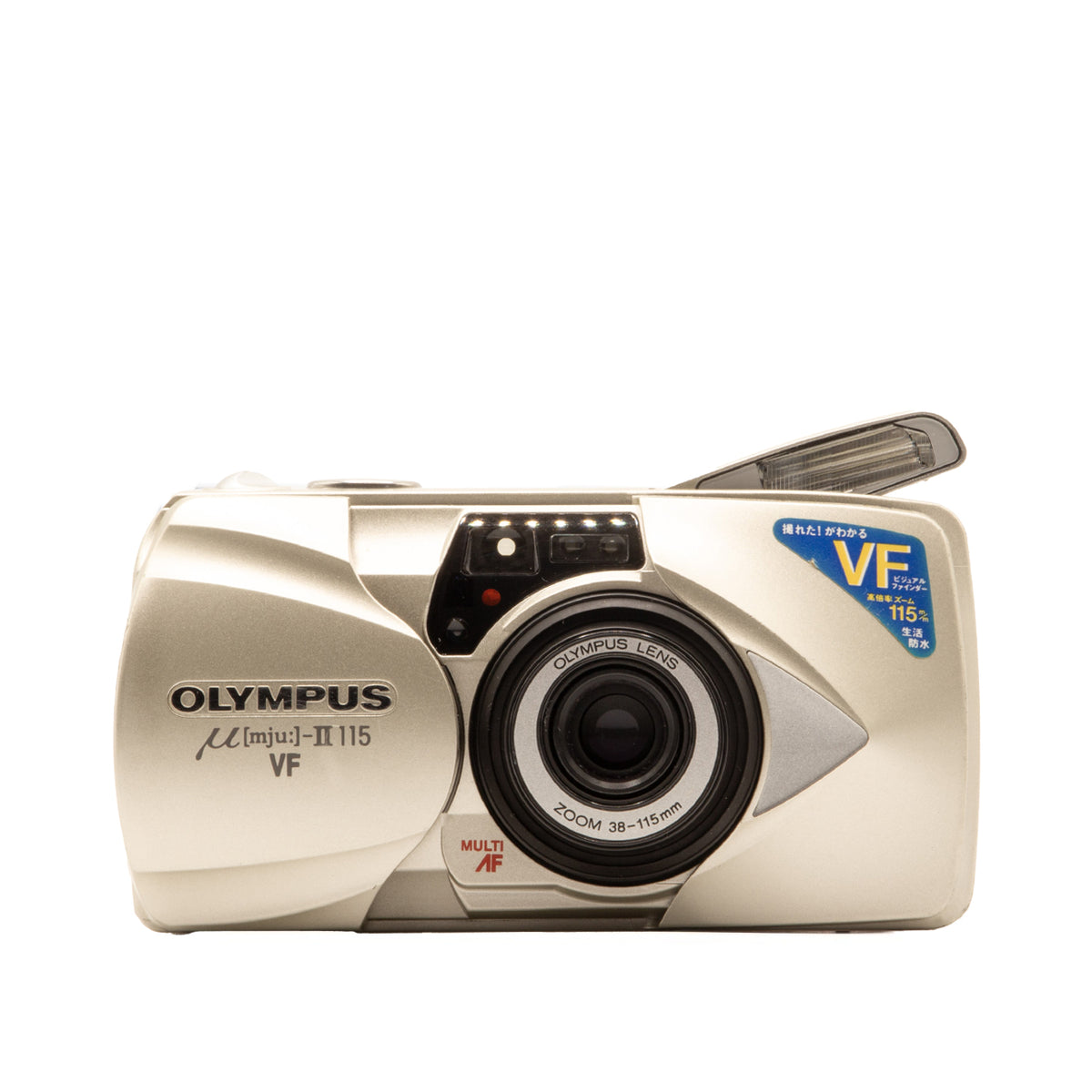
MJU II 115 VF: a zoom, not the fixed-lens MJU II
The Olympus MJU II 115 VF Zoom has a 38–115mm lens with a maximum aperture of f/4.6 at the wide end and f/10.9 at the long end, according to Olympus's original 115 VF specification. That is not the fixed 35mm f/2.8 lens of the MJU II.
The practical choice is how you want to frame a scene. The 115 VF lets you change focal length from the same spot; the fixed-lens MJU II keeps one focal length. Compare the exact lens and condition notes, rather than choosing on the MJU II name alone.
Mju II Zoom 80: The Pocketable Zoom
The Mju II Zoom 80 Deluxe has a 38–80mm zoom lens. It is a different camera from the fixed-lens MJU II, not the same model with an added zoom. Check the exact model name, lens range and individual condition notes before choosing. Keep vintage cameras dry and do not rely on their original weather resistance.

Photo: The 35mm Club
Mju III Wide 100 and 150: The Big Range Zooms
The Mju III Wide 100 starts wider at 28mm and reaches 100mm, which suits landscapes and tight indoor spaces. The Mju III 150 covers 38–150mm for the longest reach. Both are compact zooms, a little larger than the Mju II, at roughly 210–220g.

Photo: The 35mm Club
Which Olympus Mju Should You Buy?
- You prefer one focal length: The Olympus MJU II has a fixed 35mm f/2.8 lens. You frame the photo by choosing where to stand, rather than turning a zoom control.
- You want to change the framing from one spot: Compare the exact zoom model and its stated lens range. MJU zoom names describe different cameras; do not assume they share the fixed-lens MJU II's features.
- Your budget is the deciding factor: Compare current prices alongside condition grades and individual notes. Check the specific camera's battery requirement and what is included before deciding. Avoid choosing on the model name alone.
Start with how you want to take photos, then compare the individual listings. A fixed lens and a zoom offer different ways to frame a scene; neither makes a blanket promise about the photos you will get.
The Honest Trade-Offs
All of these cameras are around 25 to 35 years old, so condition matters more than model. Weather seals perish, batteries can leak and flashes wear out, so buy one that's been inspected and comes with a warranty.
Every Olympus Mju we sell is cleaned, inspected, tested and graded the same honest way. Every model runs on a battery you can pick up separately, like our CR123A battery. Stock is one-of-a-kind, so check the listings for what's available now.
Olympus Mju Family FAQ
What's the difference between the Mju I and Mju II?
Both have a fixed 35mm lens. The Mju I has a maximum aperture of f/3.5, while the Mju II has a maximum aperture of f/2.8. Check the individual camera's condition and keep vintage cameras dry; do not rely on their original weather resistance.
Is the Mju III better than the Mju II?
Not necessarily. The Mju III models are zooms with more flexibility, but the Mju II's prime lens is brighter and the camera is smaller.
Are Mju and Stylus the same camera?
Some Olympus cameras have different Mju and Stylus names by region, but those names do not identify one universal model. The fixed-lens MJU II is also known as the Stylus Epic. Check the complete model name and lens specification: a Mju or Stylus zoom is a different camera from the fixed 35mm f/2.8 MJU II.
Do all Mju cameras take the same battery?
Many use a CR123A, but check the listing for your model.
Ready to Pick Your Mju?
Browse our film cameras collection and snap back to reality!


